Parking Lot Sealcoating in McKinney, TX
Typical cost: $0.15 – $0.35 per square foot depending on lot size and condition; a typical 25,000 sq ft lot runs $4,000 – $9,000 sealed and re-striped
Asphalt is held together by a petroleum binder, and the North Texas sun cooks that binder out of it a little every day. The surface fades from black to grey, goes brittle, and starts shedding fine gravel — and once cracks open, our clay soil finishes the job, swelling and shrinking under the pavement until small cracks become alligatored patches. Sealcoat is the sunscreen: an emulsion layer that blocks UV and water, restores the black finish, and resets the clock on the surface.
The economics are lopsided in the owner's favor. Sealcoating costs cents per square foot; asphalt replacement costs dollars per square foot. A lot on a two-to-three-year sealcoat cycle routinely lasts a decade longer than a neglected one, which on a large commercial lot is six figures of deferred replacement. It is the rare line item where the cheap option and the smart option are the same option.
The work itself is scheduled around your operation: we section the lot so part of it stays open, or take the whole surface overnight and on weekends. Sealcoat covers every existing line, so re-striping is part of the same project — the lot comes back black, lined and ready before Monday's traffic.
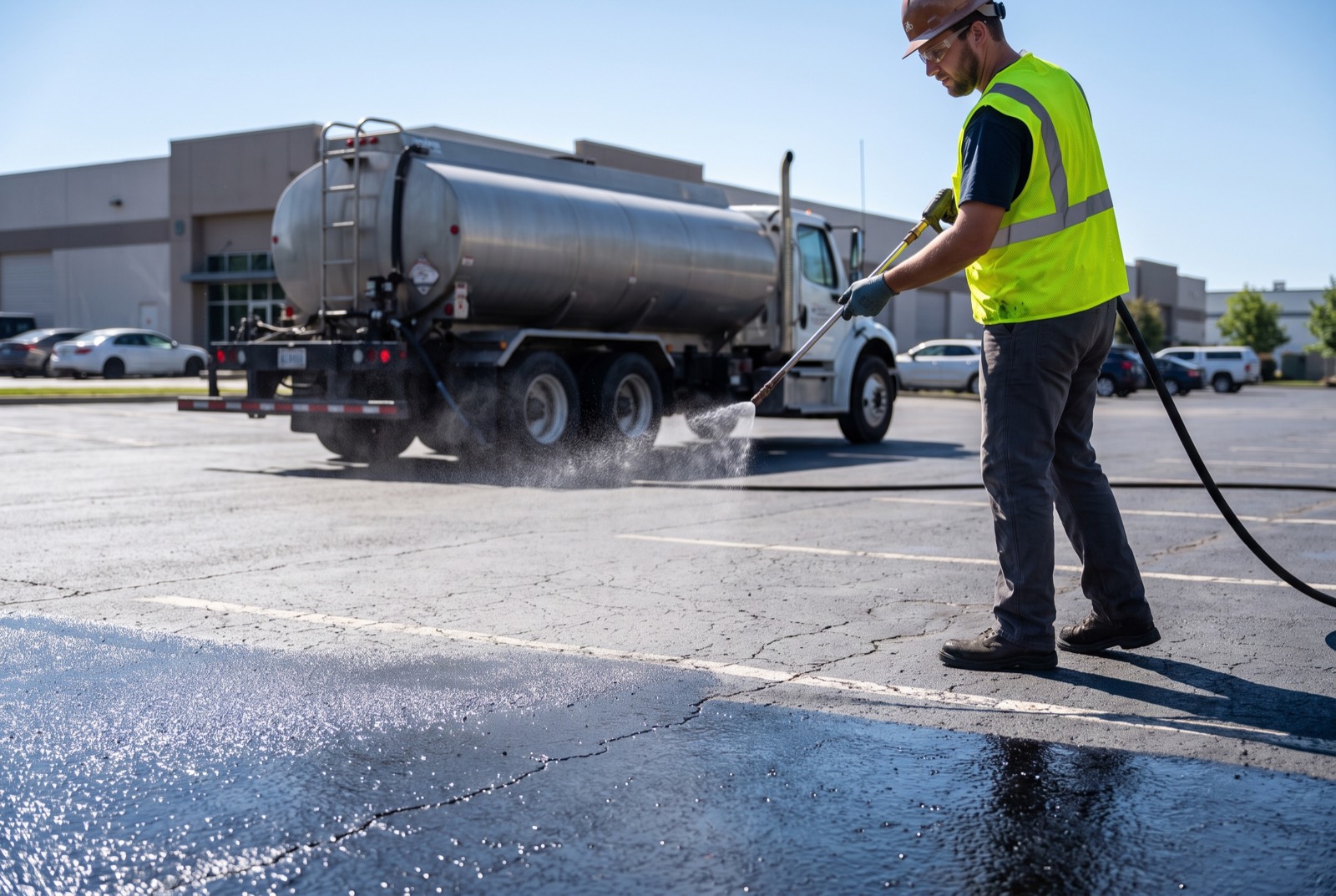
Sealcoat going down - the wet black line where protected pavement begins.
What is included
- Commercial-grade sealcoat emulsion, machine and hand applied
- Two-to-three-year maintenance cycles with scheduled reminders
- Sectioned or overnight scheduling so the property stays open
- Re-striping included in the same mobilization
- Per-square-foot pricing you can compare across bids
What is actually in the sealer
The standard commercial product today is an asphalt-emulsion sealer — essentially liquid asphalt suspended in water, fortified with polymers and blended with fine silica sand so the finished surface has traction instead of a slick sheen. You may still hear about coal-tar sealers, which dominated this trade for decades; they are being phased out across the country over environmental concerns, and a growing list of cities and national retailers will not allow them on their properties. If a bid does not say what sealer is in the tank, ask. The application itself is two coats: the first is worked into the pores of the pavement by squeegee or brush, the second is sprayed for an even finish. One heavy coat is not the same thing as two correct ones, and it does not last like them.
When a lot can be sealed — and when it cannot
Sealer has rules. Brand-new asphalt cannot be sealed for six to twelve months — the surface oils in fresh pavement have to oxidize out first or the sealer will not bond, which is why a new lot gets striped right away but sealed on its first birthday. Beyond that, the pavement needs to be 50 degrees and rising with no rain for 24 hours, which is what makes this a March-through-October trade in North Texas. After application, the lot carries cars after about 24 hours and trucks and dumpsters after 48 — the reason sealing jobs get sectioned or scheduled over a weekend, so the property never fully closes.
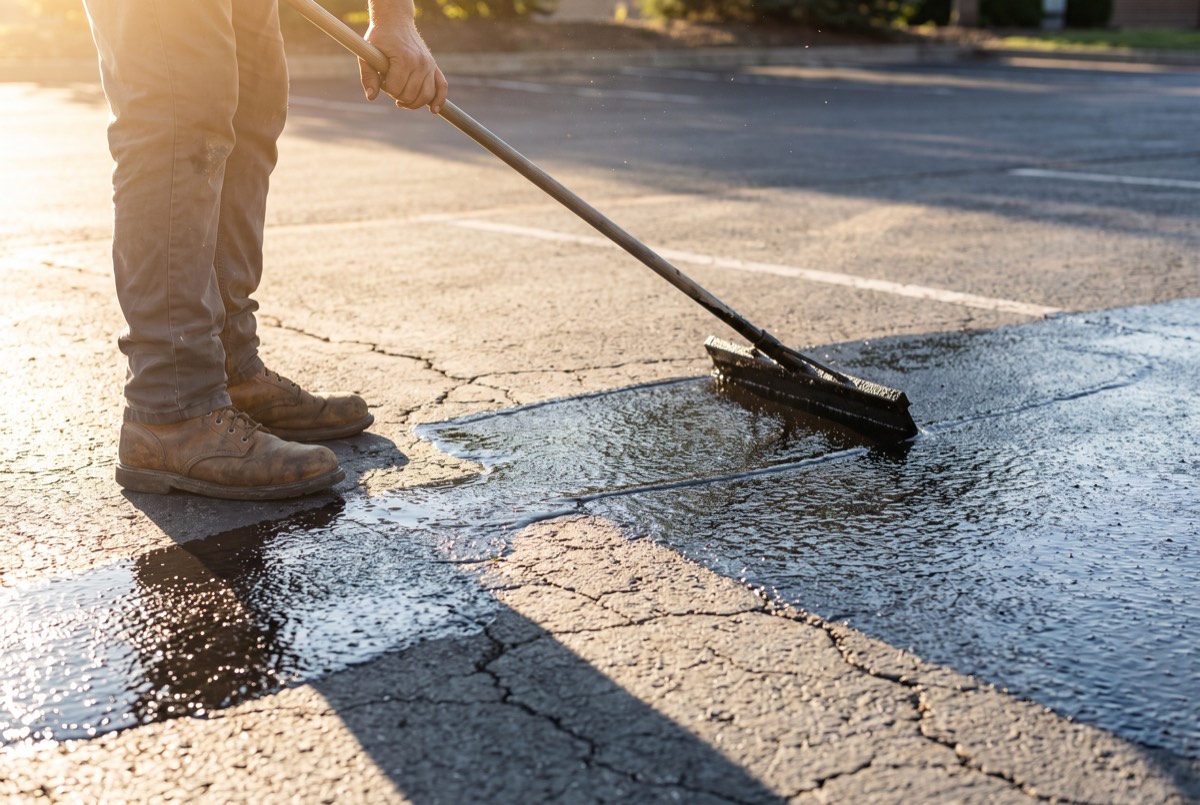
First coat going down by squeegee - worked into the pores, not just sprayed over them.
Serving McKinney, Frisco, Allen, Plano, Prosper and nearby
This service is available across our full coverage area. See the service area map for the complete list, or call (469) 203-8029 to check a specific address.